
Unlock playable kings by completing the objective displayed on each locked king card. The king-selection screen shows the requirement and its progress, and the run's ending screen announces a completed unlock. On a fresh PC account, the King of Nothing is the starting playable ruler. Inspect the locked cards before planning a run so you pursue the actual objective on your version.
The important limitation is that unlocks are not all the same task. Do not assume every king requires a campaign victory, the same difficulty, or reaching a particular king level. This guide follows the visible objective system for version 0.9.8 and explains how to verify the requirement associated with Time without inventing a numerical requirement table for the other rulers.
Find the requirement before starting a run
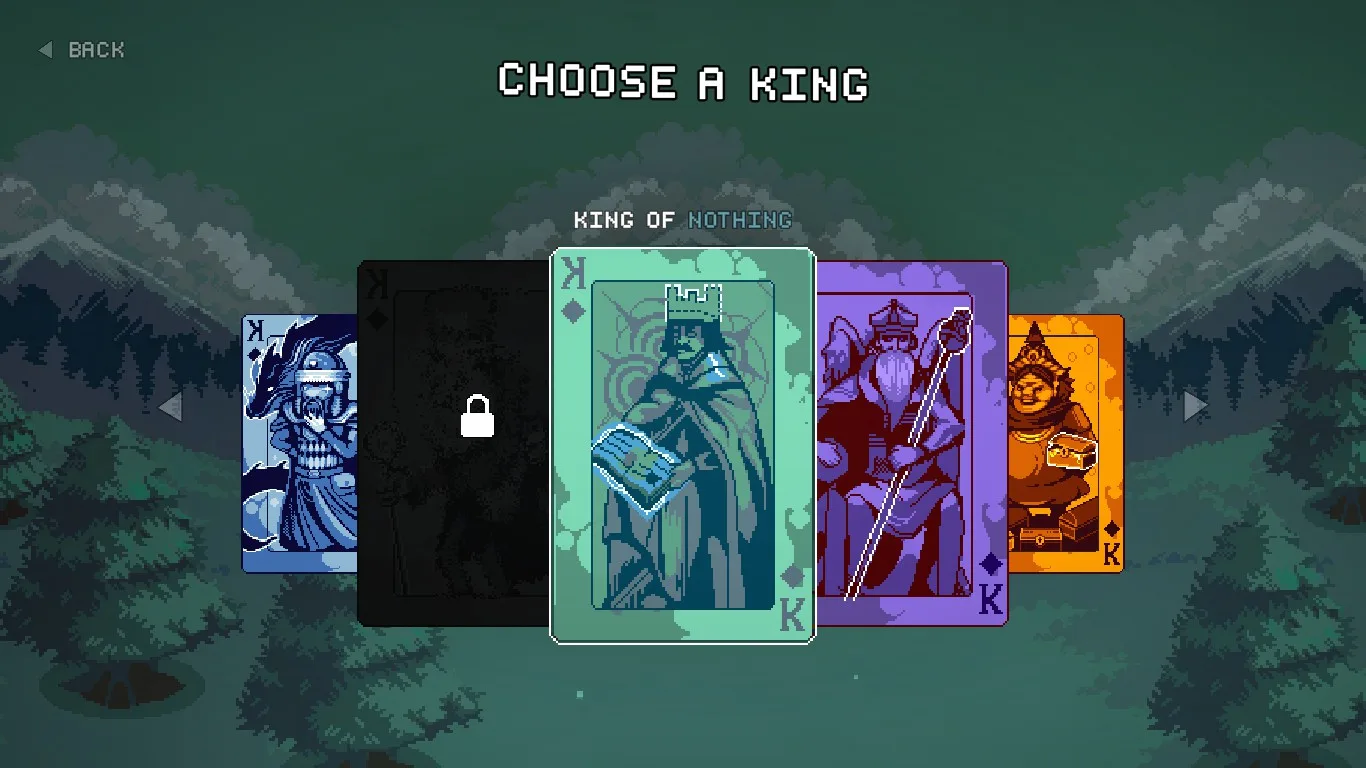
Check the locked ruler card in your current game for its objective and progress.
Open the king-selection screen and rotate through the available ruler cards. A locked card is the place to check its quest and current progress. Read both the requested action and any condition attached to it. A task involving a total across runs should be treated differently from one asking for an event during a single attempt.
Make a short note of the target before beginning. Record the king's name, the displayed objective, and the current counter when one exists. This prevents a common mistake: playing toward an achievement or perk unlock and expecting it to unlock a ruler that has a different requirement.
Choose your playable king around the requested action. If the requirement benefits from a particular card role, use an available ruler that naturally supplies that role or can obtain it through normal rewards. Keep the plan modest. The goal is to satisfy the objective shown by the game, not to reproduce a spectacular late-game kingdom.
Finish the attempt normally and review the result screen. A new-king pop-up is the useful confirmation that the objective completed. Return to selection afterward and check that the previously locked card can be chosen. Those two checks establish the outcome more reliably than assuming an animation or a high ending year must have unlocked something.
The playable roster you are working toward
| King | What changes when you can select it | Main reason to try it |
|---|---|---|
| Nothing | Initial balanced starting deck | Learn troop, tower and support roles |
| Spells | Enchantment and spell-oriented starting tools | Develop selected troop recipients |
| Greed | Economy-centered starting tools | Connect gold to a fighting force |
| Blood | Sacrifice and summon-oriented starting tools | Convert destruction and deaths into growth |
| Nature | Health, population and wildlife tools | Sustain durable troops |
| Stone | Tower and fortification tools | Build supported defenses |
| Progress | Upgrade and recycling tools | Plan plot-level interactions |
| Nomads | Movement and plot-reuse tools | Build around an action sequence |
| Time | Time-themed starting tools | Explore time and enchantment interactions |
Unlocking a ruler gives you access to that ruler's starting identity. It does not mean all its perks are already earned, nor that every card you obtain during the next run must belong to its deck. You can borrow rival cards while playing another king, but that is different from selecting the rival as your starting ruler.
This distinction also helps you choose an unlock priority. If you already enjoy a borrowed Quarry, Stone may be worth pursuing. If Library interactions interest you, Spells gives that idea a more central role. Pick the next locked king whose deck teaches a mechanic you actually want to use.
Keep king unlocks separate from perk progression
Perks are progression upgrades earned through king levels. They change starting advantages or specific card interactions, but their acquisition system is not the same as the objective on a locked ruler. A king can be playable while a perk you want remains locked.
When you finish a run and receive a perk, read the reward rather than assuming it is a new ruler. Likewise, when you unlock a king, expect to build familiarity with its starting deck before comparing it with a heavily developed ruler. The newly available deck and the fully developed perk page are separate stages of progression.
The order of individual perk rewards is not a reliable universal guide to ruler unlocks. Your account's available perks can differ from a screenshot or a player's remembered leveling path. If a locked king card shows a progress task, use that card as the governing instruction. Chasing an unrelated perk because its name resembles the king's theme can waste several runs.
Rainbow perks create another possible confusion. They affect the perk screen and multipliers, whereas rainbow cards are special cards used within a run. Neither category should be mistaken for a playable Rainbow King. Read the category of the reward before deciding whether the roster has expanded.
Verify King of Time's current objective
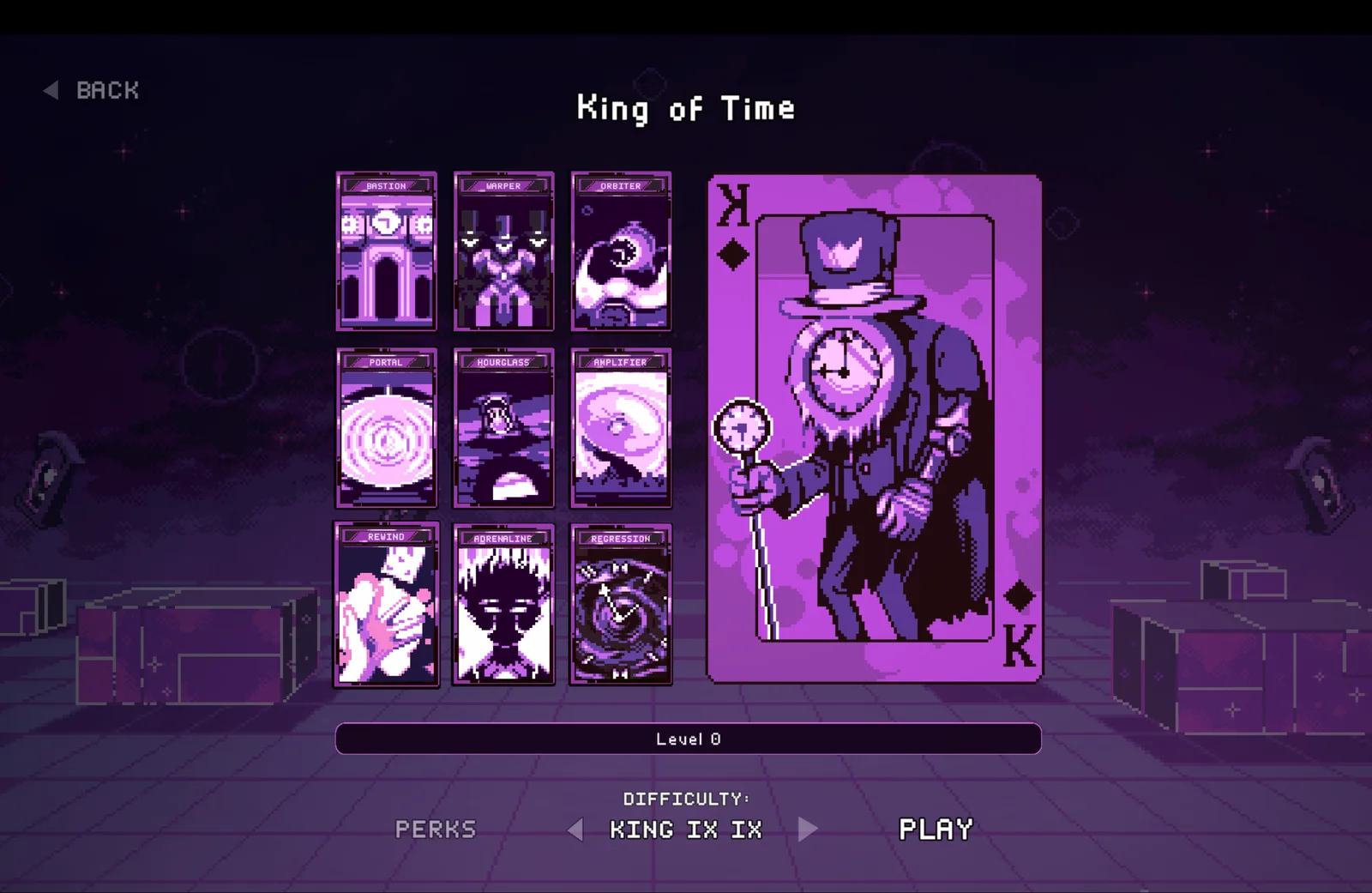
Ruler identification screen; this older illustration may show a previous deck arrangement. Read current tooltips for card effects.
Open the locked King of Time card and read its current objective, conditions and progress. Use that wording to plan your attempt. A remembered numerical target or counting rule from an older version is not enough to establish what version 0.9.8 requires.
Past community descriptions of Time's unlock and reports of counter mismatches do not confirm the present requirement. Do not assume that separate runs contribute to one total, that a particular year threshold applies, or that an old save automatically receives credit. Those points must be established by the condition displayed in your current game.
Before committing to a long session, record the displayed objective and any counter. Play an ordinary fresh attempt that addresses that objective, reach its result screen, and return to selection. Compare the result with what the card asked you to do. If progress changes, that confirms the observed action contributed on your save; it does not establish every possible counting rule.
Do not choose a very long Endless run solely because an old discussion described extreme year totals. First determine whether the current card asks for that kind of progress. Avoid changing your computer's calendar or using a time-loop strategy as a substitute for reading the actual condition.
If the card's progress remains unchanged, preserve the objective text, version and before-and-after state for the diagnostic steps below. Playtime in hours is not proof that a ruler's specific condition has been satisfied, and a historical zero-counter report does not establish a current bug or promise retroactive credit.
Confirm progress with a controlled attempt
A simple progress check is more informative than repeatedly starting different runs. Use one save, one target and an ordinary completion path. Write down the starting counter and return to the same locked card afterward. The question is whether the requested action produced progress, not whether the run was impressive.
- Check that the target ruler is still locked and read the current requirement.
- Record its progress and the account or save you are using.
- Start a fresh run on the updated game.
- Perform the action the card asks for while preserving a normal playable kingdom.
- End the attempt through the game's ordinary result flow.
- Return to the selection screen and compare the progress or unlock state.
Starting fresh matters after patches. The current update instructions say previous runs do not contain updated run data. A continued old run is therefore a poor place to verify present behavior if a counter or interaction seems inconsistent. Use a fresh attempt before concluding the unlock system is broken.
If the counter rises but the ruler remains locked, compare it against the displayed target. Partial progress is not failure. If the target is complete but no selection is available, preserve what the game shows: version, objective, counter and result state. Those details make a report actionable without guessing at a hidden cause.
Choose useful unlock attempts
A good unlock attempt can advance the objective and teach you something about the deck you are already playing. Prefer tasks you can describe in one sentence. If a locked card asks for a particular type of action, create a kingdom that can perform it safely rather than filling the board with every card that seems thematically related.
For cumulative tasks, favor sustainable normal play. A failed run may still contain gameplay, but use the counter to verify what the game actually credits; do not assume a specific amount is counted from a quit, restart or altered-year sequence. Checking after a representative attempt gives you better information than multiplying a hypothetical rate by an arbitrary playtime goal.
For an objective that depends on cards, distinguish availability from ownership. Fighting a king can supply cards from its deck during the run. A shop may present another useful card. Those access routes can help complete a requirement without selecting the locked ruler first, but receiving one of its cards is not itself proof that the ruler unlocked.
For a task you cannot yet support, pursue another king or improve your available perks before forcing the same failed sequence. The best priority is the objective closest to what your current deck can actually do. A roster unlock is useful because it opens another way to play, not because it must be completed in a universal order.
Special enemy kings are not missing unlocks
The Rainbow King belongs to the special enemy side of the roster. Its cards have special effects, and receiving rainbow loot is part of runs, but there is no ordinary playable Rainbow King card to unlock in the selection circle. Do not confuse the enemy preview or a rainbow card with an undiscovered starting ruler.
Chaos is also a special enemy identity, associated with stronger spin-off cards and the game's later challenges. It is not an additional selectable king after you unlock the nine playable rulers. A screenshot showing a Chaos enemy therefore does not imply a secret roster requirement.
This matters when using older discussions or collectible images as a checklist. Artwork, trading cards and enemy leaders can show characters that are not playable selections. Use the selection screen as the roster checklist and the Compendium for encountered cards; those interfaces answer different questions.
Before using a newly unlocked king
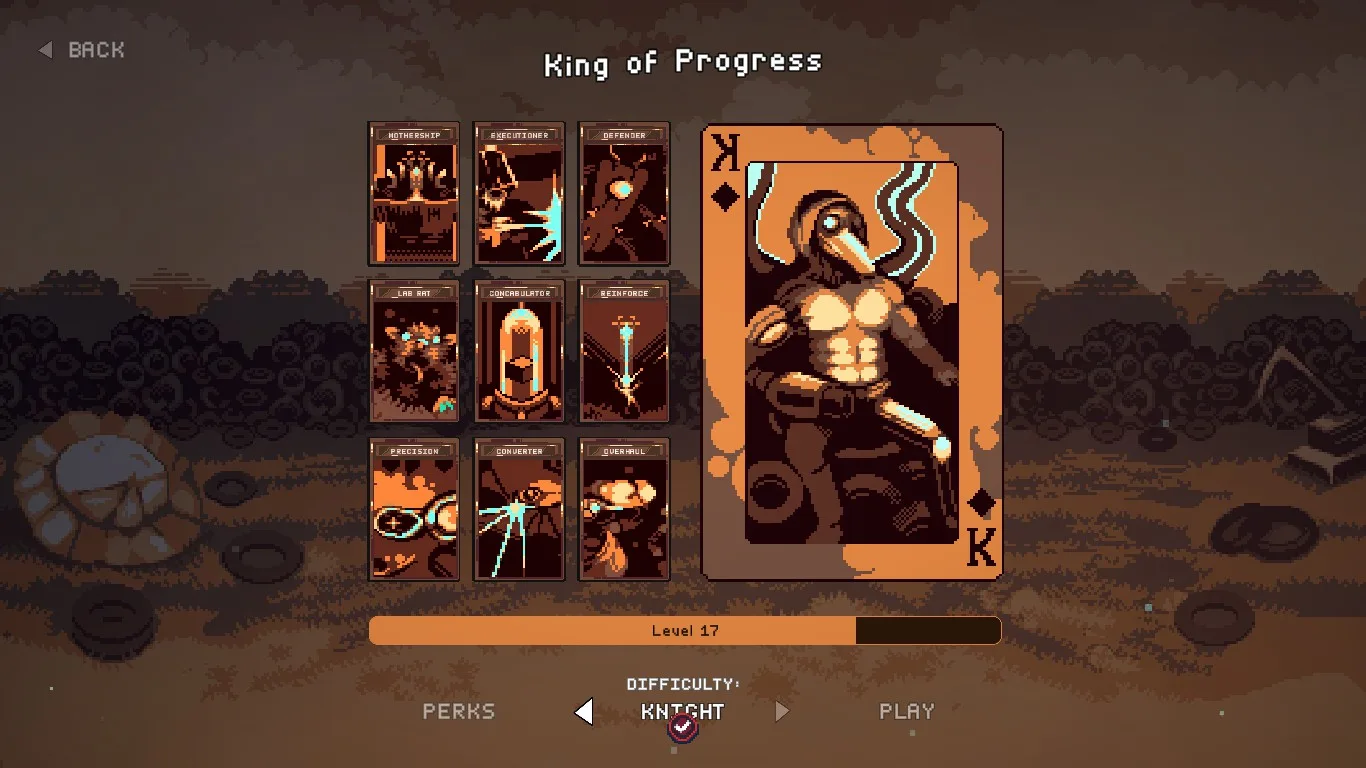
Ruler identification screen; this older illustration may show a previous deck arrangement. Read current tooltips for card effects.
Read the new ruler's deck before starting an important attempt. Identify a damage source, a way to survive and the deck's growth mechanic. Progress, for example, benefits from planned upgrades, while Blood asks you to understand what a destruction action costs and what receives its benefit.
Check current descriptions instead of copying a launch-era list. Several cards changed in the large deck rework and subsequent patches. Reinforce is now a combat-health effect, and current Blood cards and summons differ from the older Vampirism and Imp-centered descriptions. A new unlock is easier to learn when the plan matches the current deck.
Start with a manageable learning objective for the new king. Do not immediately judge it against an established ruler with more familiar perks and a practiced opening. A first run that reveals an important adjacency requirement or a bad sacrifice is still useful preparation for the next attempt.
For multiplayer, review the seasonal decree pool before deciding that the new king cannot support an intended plan. The pool is available in the lower-left lobby. A decree absent from the season cannot be the basis for judging whether your unlock was worthwhile.
If a ruler remains locked
Return to the locked card and resolve the smallest uncertainty first. Verify the objective text, the current progress, the version and whether the attempt was fresh. Then repeat a normal action that should advance that exact task and inspect the result. Do not substitute achievement completion, hours played or a borrowed card for the displayed unlock condition.
If progress is still inconsistent, retain those observations for a bug report rather than editing a save based on an old forum path. Save formats and counters can change, and an altered number does not verify that the ordinary objective works. The useful outcome is a selectable ruler on your current save, confirmed after the result screen and on the selection card.