
The King of Nothing is the best default choice for flexible, understandable runs. Pick the King of Progress when you want an upgrade-driven strategy, the King of Stone for tower defense, and the King of Blood for sacrifice and summon engines. Those recommendations answer different goals; they are an editorial assessment of each deck's mechanics, not a measured win-rate ranking.
This comparison uses version 0.9.8, Patch #31. All nine playable kings have distinct bases, starting decks, perks and decrees, but a run can borrow cards from rival kings. Your available perks and the cards you receive can matter more than a ruler's place on a general list. Choose the ruler whose starting tools solve your immediate problem, then adapt the rest of your board.
The best king for each kind of run
| Your goal | Recommended king | Main reason | Main trade-off |
|---|---|---|---|
| A flexible general-purpose run | Nothing | Clear troops, support buildings and upgrade tools | You still need to turn flexibility into a focused board |
| An upgrade engine | Progress | Lab Rat adjacency and plot-level interactions | Card order and placement demand attention |
| Tower-centered defense | Stone | Quarry, Wallmaker and specialized siege tools | Damage needs enough time to reach the enemy |
| Sacrifices and summons | Blood | Allied destruction and deaths feed other cards | An engine can consume its own defense |
| Durable troop growth | Nature | Forest, Boar and population support | Early survival must support the long-term investment |
| Enchantment stacking | Spells | Library and enchantment-oriented units | Recipients and protection must already exist |
| Gold-dependent forces | Greed | Economy feeds Dispenser and Mercenary plans | Spending can weaken a reserve-dependent plan |
| Movement and rebuilding | Nomads | Movement, plot clearing and redeployment | A fixed adjacency plan can obstruct the intended engine |
| Time-themed scaling experiments | Time | Distinct time and enchantment interactions | Recent balance changes make old recipes unreliable |
Use the first column as the selection screen. If your goal changes, reconsider the king instead of carrying a ranking from an unrelated mode into the new run. A tower specialist need not be the easiest ruler for learning troop protection, and a technically elaborate engine need not be the most reliable way to finish an ordinary campaign.
Why Nothing earns the default recommendation
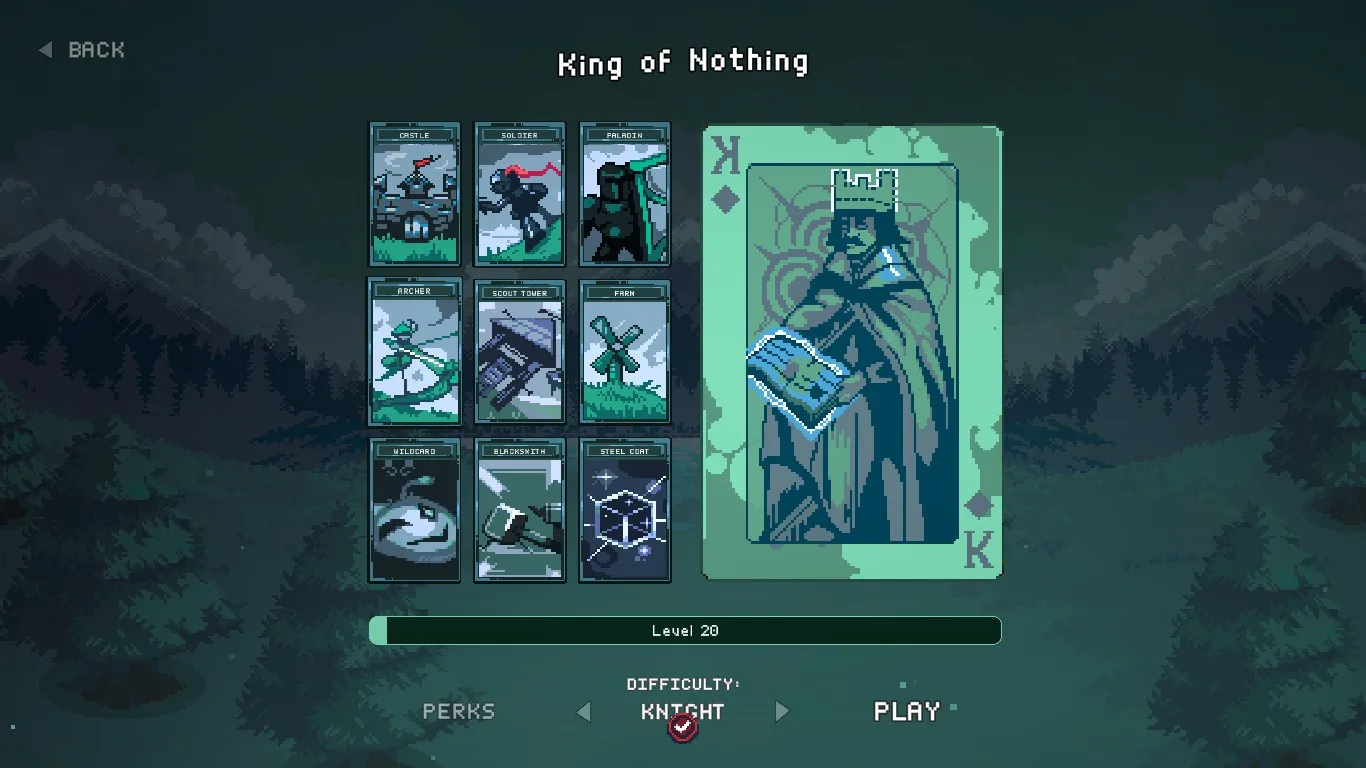
Ruler identification screen; this older illustration may show a previous deck arrangement. Read current tooltips for card effects.
Nothing has a useful starting vocabulary: a Castle, melee troops, ranged troops, a Scout Tower, Farm, Blacksmith, Wildcard and Steel Coat. That makes the deck easier to reason about. You can identify a damage dealer, choose whether it needs more bodies or stronger attacks, and recognize the support card that addresses the shortfall.
A Farm supports troop count. A Blacksmith develops nearby damage. A Wildcard gives upgrade flexibility when a specific duplicate does not arrive. These roles help you make productive choices from imperfect rewards. You are not required to abandon your opening because an off-faction card appears; the deck has room to incorporate a different troop, a tower or an additional support effect.
The limitation is that a flexible deck does not automatically produce a coherent kingdom. If you spread upgrades across unrelated attackers and put support buildings where they reach weak recipients, Nothing loses the practical advantage that makes it attractive. Select it when you want to solve the board in front of you, rather than chase a complicated sequence before you have defensive stability.
Patch #31 slightly buffed Soldier. That is a reason to reconsider very old lists that automatically dismissed it, but not proof that Soldier is now the game's strongest unit. Nothing's recommendation rests on accessible roles and flexible decisions, not a claim that every card in its deck beats the alternatives.
Progress for players who enjoy sequencing
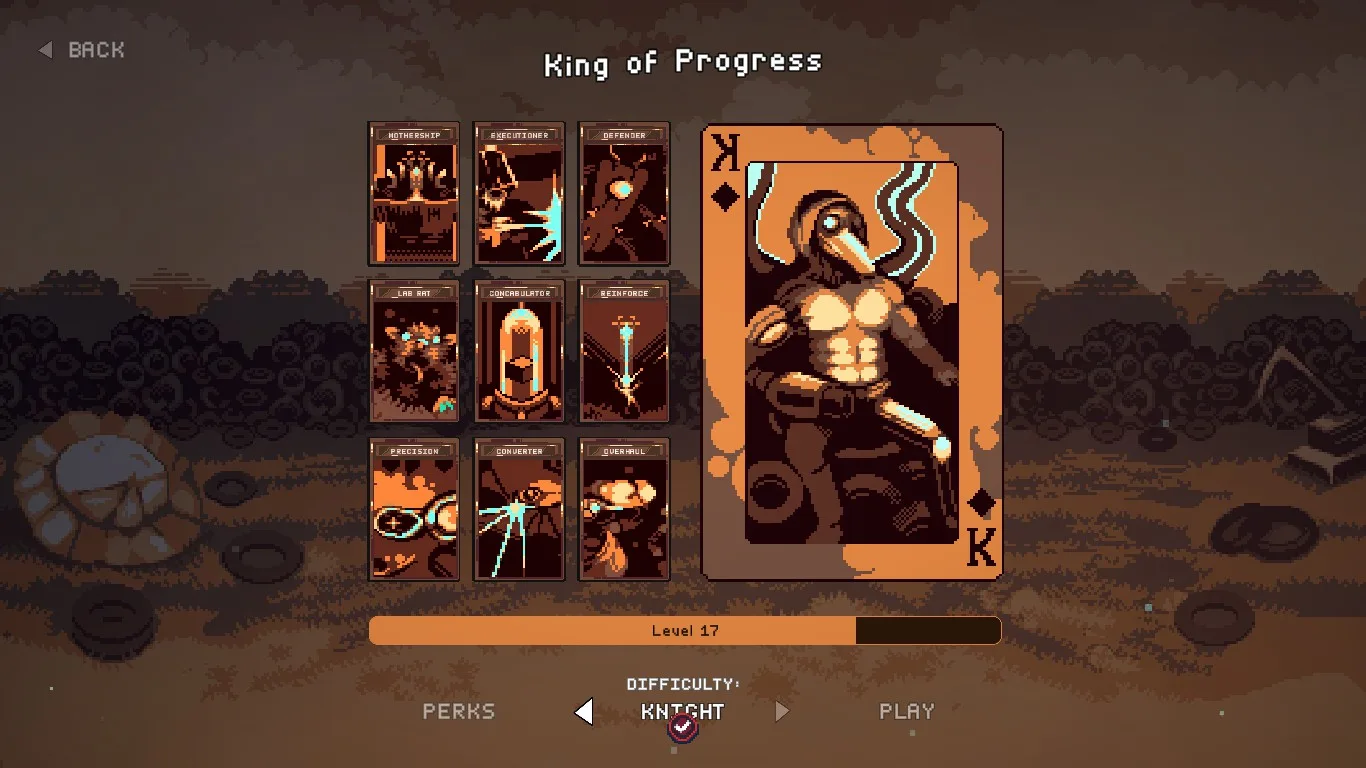
Ruler identification screen; this older illustration may show a previous deck arrangement. Read current tooltips for card effects.
Progress is the clearest recommendation when the task is to build around upgrades. Lab Rats can level beyond ordinary plot limits, and nearby leveling is central to their value. The practical attraction is that an action improving one part of the board can also advance another. This rewards deliberate placement and a hand that supplies useful upgrade actions.
The price is planning complexity. A kingdom may look busy without delivering the interactions you intended. Before choosing Progress, be comfortable checking which plots are adjacent and which action produces an upgrade. A powerful late-game concept is not a substitute for a troop or defensive solution that survives the next battle.
The deck has changed substantially. Recycler is part of the current pit-based toolkit, while Reinforce now gives health growth during combat and can heal beyond maximum HP. Old guides that describe Reinforce as upgrade-triggered attack growth are describing a previous design. Choose Progress for its current upgrade and recycling options, not to reproduce that removed interaction.
For a regular campaign, use its special mechanics as a benefit attached to a defensible board. For experimental scaling, accept that card availability and ordering are larger constraints. Progress has an attractive ceiling for players who like solving those constraints; this comparison does not convert that ceiling into a guaranteed result at a particular difficulty.
Stone when towers are the plan
Stone gives you a direct reason to commit to constructions. Quarry develops tower damage across the kingdom, avoiding the adjacency requirement of some other support buildings. Wallmaker and siege tools give the deck a defensive identity, while Trebuchet benefits from a board containing constructions.
That identity is useful when you would rather develop a smaller set of supported defenses than manage a population engine. It also gives reward choices a clear test: will this card strengthen the defenses, buy firing time, or solve an enemy that currently reaches your base? A card serving none of those purposes is less attractive even if it appears high on a general tier list.
Stone is not simply an immobile collection of damage numbers. Your towers need a battlefield in which they can act. A defensive card can be valuable because it creates that time, even when it contributes little direct damage. Conversely, another tower may be redundant if the actual failure is the speed of the enemy advance.
Current balance gives Stone more reasons to be reconsidered. Trebuchet projectiles gained area damage in the deck rework, Trapper traps gained stun and a larger unit count, and Patch #31 increased Trapper damage again. Enemy Ballistas were nerfed in singleplayer and Quest mode. Do not apply that enemy change as a claim about your own Ballista or multiplayer strength.
Blood for a deliberate sacrifice economy
Blood is the recommendation when you want destruction and allied deaths to produce value. Demon Altar grows through allied deaths. Mangler now summons meat trolls and gains from consuming units, and Patch #31 added HP gain when it destroys them. Cemetery has skeleton interactions, while Pagoda's ghost population is connected to destruction during the run.
This makes Blood more specialized than Nothing. A unit can have two jobs: hold the enemy briefly and contribute to a later summon or growth effect. The important distinction is intention. Losing troops because they performed their engine role is different from losing the only defense before that engine becomes useful.
Select Blood if you enjoy balancing that trade. Avoid it as a default answer when your recurring problem is that you cannot keep any frontline alive or cannot identify which plot is consuming which troop. Its deck rewards understanding the cost of an interaction, not simply placing every sacrifice-related card available.
Oblation belongs to the current Blood design; Vampirism does not belong to the old role it filled in launch-era deck lists. This matters when comparing Blood against other kings. Advice built on healing with the previous Blood card is not a current reason to recommend it.
Nature and Spells offer different troop engines
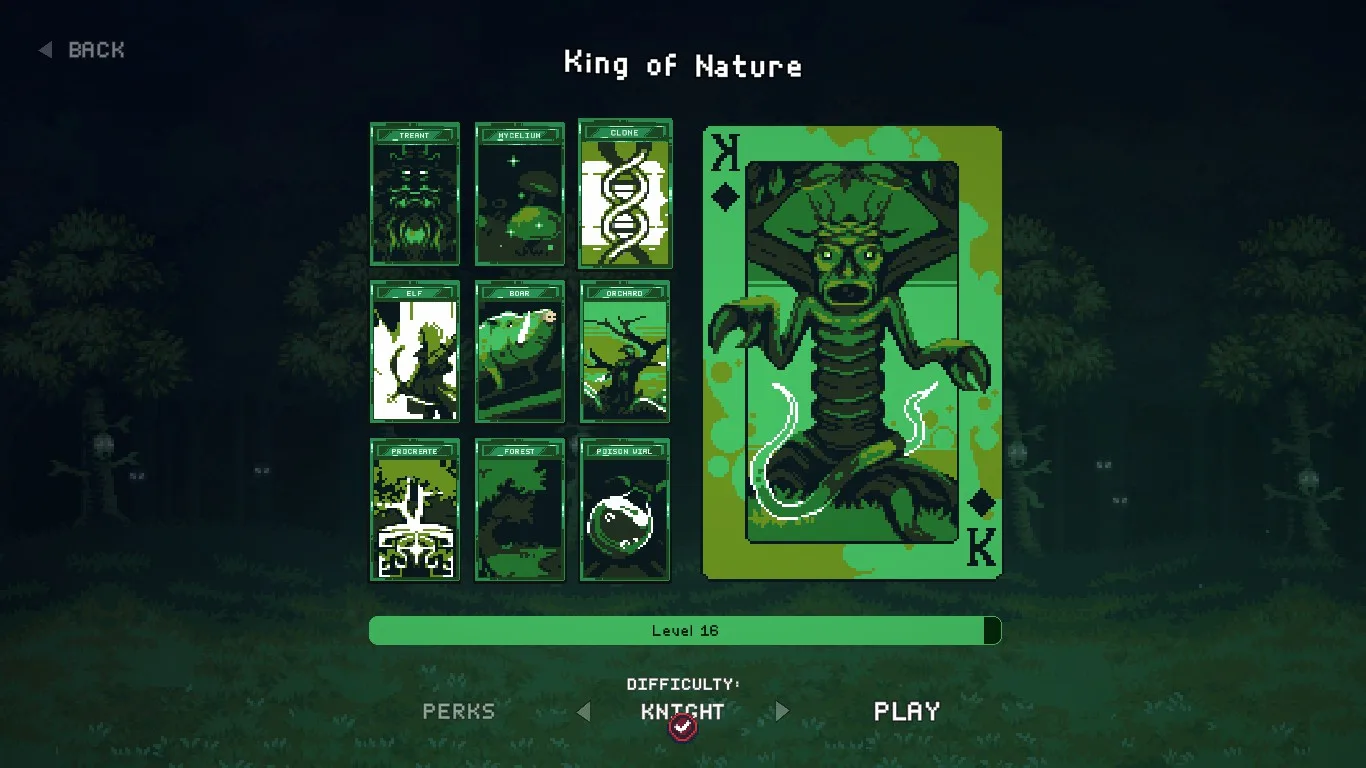
Ruler identification screen; this older illustration may show a previous deck arrangement. Read current tooltips for card effects.
Nature is a good choice if you want a durable troop-oriented kingdom. Forest supports health, Boar connects its health to a rider's power, and population tools make troop count part of the plan. The attractive pattern is sustained development around recipients that can survive long enough for that development to matter.
Its trade-off is the interval before growth becomes decisive. An early support piece with a long future can still be the wrong immediate play if the kingdom has no damage or protection. Choose Nature when you are prepared to measure whether the next battle is safe while preserving the growth plan.
Spells answers a different preference. Library and enchantments let you invest repeatedly in selected units. Wizards, Warlocks and Shamans provide distinct ways to use that investment, with a Shaman contributing support rather than functioning as an ordinary attacker. This can produce a focused kingdom, but you need eligible recipients and a way to protect them.
Patch #31 slightly buffed Wizard and fixed a broken Surge and Library interaction. That fix should remove an obsolete exploit from your expectations. Recommend Spells for legitimate enchantment development, not for a claim that a historical interaction still creates automatic wins.
Between these two kings, choose the bottleneck you enjoy managing. Nature asks whether health, population and time can sustain your force. Spells asks whether your enchantments, recipients and support placement form a useful chain. Neither is categorically superior for every reward pool.
Greed, Nomads and Time require a clearer objective
Greed is suitable when you explicitly want money to feed combat. Vault now levels automatically each year, Dispenser benefits from income, and Mercenaries connect unit count to your gold reserve. That connection creates a real opportunity cost: buying an improvement may reduce a reserve-dependent force. The best choice is therefore the one that leaves a stronger fighting board after the purchase.
Nomads suits players who want movement and rebuilding to matter. Its tools reward thinking about occupied and emptied plots, not only a finished arrangement. Choose it when you are comfortable reading a sequence of actions as the engine. A neat static kingdom is not necessarily the right measure of its progress.
Time is a reasonable experimental choice once you understand ordinary survival and support. Hourglass late-game attack-speed progression was rebalanced in Patch #31, while Orbiter enchantment inheritance received a fix. These changes make old extreme-number stories a poor basis for declaring it the strongest ruler. Choose it because the current mechanics interest you, and read the actual tooltips before committing to an old recipe.
Make the choice match your account and mode
A newly unlocked king without the perks you want is a different practical option from a developed king with a coherent loadout. Start with the resources your account actually owns. If you prefer a particular specialist but its starting board repeatedly stalls, use an established ruler to build your understanding before judging the specialist's entire deck.
Multiplayer also changes the comparison. Patch #31 introduced a seasonal decree pool containing universal, rainbow and king-specific selections. Check the current pool in the lower-left multiplayer lobby before planning around a decree. A recommendation requiring an unavailable decree has no practical value for that season.
For the next run, write down one sentence explaining your choice: flexible improvement, supported towers, upgrade chains, sacrifice growth or another specific goal. If the sentence only says that someone called the king overpowered, it does not tell you how to evaluate your first rewards. Pick Nothing when you lack that goal; pick a specialist when you can explain the work its starting tools will do.