
A 9 Kings blessing is the delayed event forecast by the Prophet. The forecast tells you about a benefit that will arrive later in the run, giving you time to prepare the plots that can receive it. Holy strengthens blessing effects; it does not mean that every healing effect, support-building bonus, or enchantment is a blessing.
The practical task is to read the forecast, keep the run alive until it resolves, and place useful eligible targets before the event activates. This guide uses the current 0.9.8 game as its baseline. Exact blessing outcomes can depend on the forecast and your kingdom, so follow the displayed event text instead of assuming one fixed reward appears in every run.
Identify the Prophet event
The Prophet is one of the game's special encounters. Its role differs from the Merchant, which sells cards, and the Royal Council, where you select a decree. A Prophet forecast announces a future blessing rather than immediately opening another shop or permanently changing your perk loadout.
This delayed structure explains why accepting or viewing the forecast does not necessarily produce an instant change in troop statistics. The event has a preparation period. If you inspect your kingdom immediately afterward and see the same HP or troop count, that alone does not mean the blessing failed.
Read what the forecast says it will affect. A bonus to an eligible plot is different from a bonus that names a specific statistic or type of target. The distinction matters because a kingdom may contain troops, towers, support buildings, and a base with different functions. A plot being important to your strategy does not automatically make it eligible for every blessing.
Keep the forecast visible in your planning rather than treating it as an isolated event. Before playing a destructive card or replacing a troop, consider whether the plot is one you intended to prepare for the blessing. If the card removes that investment, you may solve an immediate problem while reducing the eventual benefit.
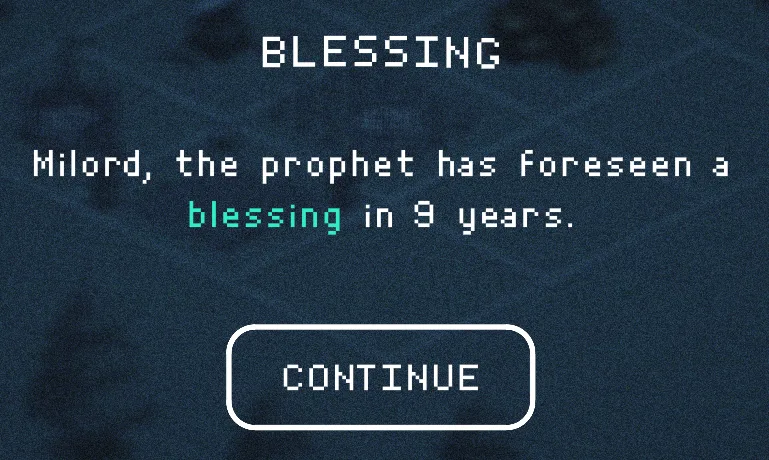
The Prophet announces a future blessing before it activates.
Turn the forecast into a preparation plan
Use the forecast to answer three questions: which plots can benefit, what must remain in place, and what threatens the run before the event happens. These questions keep the plan tied to the actual kingdom instead of to a theoretical late-game screenshot.
A useful preparation order is:
- Read the complete blessing description and any displayed target restriction.
- Identify the plot that would contribute most after receiving the effect.
- Check whether that plot already exists or still requires a card.
- Reserve the placement needed for its support relationships.
- Keep sufficient combat strength to reach the blessing.
- Review the recipient's statistics when the event resolves.
The fifth step is easy to overlook. A larger future reward has no value if your current defense cannot reach it. When choosing between a required late payoff and an immediate stabilizing card, consider the enemies you are actually facing. You may need to delay a secondary piece of the plan to preserve the run.
Also distinguish a target from its supports. A support building can improve the target before the blessing, but that does not prove that the building itself receives the same blessing or passes it to every nearby plot. Check the relevant effects separately. Adjacency is a relationship defined by the particular card, not a universal rule that makes every benefit spread.
Prepare troop count and HP carefully
Population and HP are common reasons players search for blessing explanations. Both can interact with a kingdom's growth, but they solve different problems. More troops increase the number of units associated with a plot. More HP changes how much punishment an eligible unit can take. Neither should be treated as a synonym for general damage output.
If the forecast concerns population, inspect which troop plots will remain useful after their unit count grows. A unit that already fits the kingdom's role is a more coherent recipient than a new plot placed only because it is currently in your hand. The enlarged force still needs the damage, protection, and support relationships that make it effective.
If the forecast concerns HP, identify which recipient can turn that durability into actual battlefield time. A defensive troop may hold enemies while another card deals damage. A unit that contributes indirectly may need to survive long enough for its effect to matter. The exact value depends on the army around it rather than on HP alone.
The King of Nature's kit includes cards associated with population and health, making this distinction particularly useful. Farm grows adjacent troop counts, while Forest improves adjacent troop health. These are ordinary card effects that can prepare a kingdom for a blessing; they are not the Prophet event itself.
Do not turn an older population example into a guaranteed current formula. A statement that a blessing, Holy, and a decree produced a particular number of units in an earlier version depends on the precise effect definitions and their interaction order. Read the current text and compare the recipient before and after the event instead of assuming every named doubling multiplies identically.
Understand what Holy applies to
Holy is a universal perk associated with increasing blessing effects. Its purpose is tied to the Prophet's delayed reward. It is not a blanket enhancement to everything beneficial that happens in the game. A healing ray, a yearly support bonus, and a Royal Decree can each help your kingdom without being a blessing.
Equip perks before starting a run. If you expect Holy to contribute, confirm that it is in the selected loadout and read the effect shown on the perk screen. A perk available in your collection but absent from the active layout does not contribute simply because you unlocked it.
Rainbow perks can alter how regular perks apply. This creates an additional reason to check the effective text instead of remembering only the basic description. The multiplier shown in your layout describes the active arrangement; it should not be replaced by a value copied from a screenshot of someone else's perks.
A useful comparison is the opportunity cost of the slot. Holy can improve a delayed blessing, but a different perk might supply an opening card or immediate durability. If your runs end before the relevant event, increasing a future effect may leave the actual weakness unsolved. If your opening is already stable, investing in the delayed reward may be more coherent.
This is a planning decision rather than a universal ranking. The blessing forecast, eligible recipients, chosen king, and game mode all influence the benefit. There is no reason to assume that the same perk placement is optimal for every kingdom merely because it produced a large number in one example.
Keep decrees separate from blessings
A Royal Council choice changes a run through a decree. A Prophet forecast schedules a blessing. Both can interact with the same kingdom, but they arrive through different systems and should be read independently.
For example, a decree associated with troop population can alter how your army grows. If the blessing also changes population, you have two effects to understand. Check whether the decree affects newly added units, currently active troops, or a specific event. Those phrases are not interchangeable.
Timing is equally important. An immediate effect can operate on the kingdom as it exists when you choose it, while a continuing effect may matter for later additions. Do not assume that selecting a decree after a blessing automatically applies the earlier blessing again. Likewise, do not assume that a newly placed troop inherits every effect a previous troop received.
In multiplayer, decree availability also depends on the seasonal pool. Patch #31 rotates that pool and exposes it in the bottom-left lobby screen. A blessing plan that requires a particular decree should therefore begin by checking availability. A mechanically appealing interaction is still an unreliable plan when its enabling option is absent from the season.
Keep the first decision small: use the forecast to prepare the current kingdom. Add a decree interaction only when the exact effect and current availability support it. This prevents a delayed reward from becoming dependent on several unrelated cards you have not drawn.
Verify the result when the blessing resolves
After the blessing activates, inspect the intended recipient before making another major change. Record the relevant displayed statistic or effect and compare it with the value before the event. If population was the target, inspect troop count. If HP was the target, inspect HP rather than inferring the change from the number of units visible in battle.
The game now provides more readable plot information. Patch #31 adds selected-plot highlighting and improved support-building visual effects. These help you identify the plot you are examining and distinguish it from the surrounding kingdom. The Compendium also displays card statistics, although a card's base information and your developed plot's current state serve different purposes.
When the result appears smaller than expected, review eligibility and timing first. The blessing may have affected a different subset of the board than you assumed, or your chosen recipient may have been replaced before activation. Check Holy in the active perk layout as well. These are more useful first checks than immediately attributing the outcome to a hidden multiplier.
If you updated the game during an ongoing run, begin a fresh run before comparing changed interactions. Patch #31 explicitly requires a new run for the updated data. An old save is a poor reference for determining how the current event should behave.
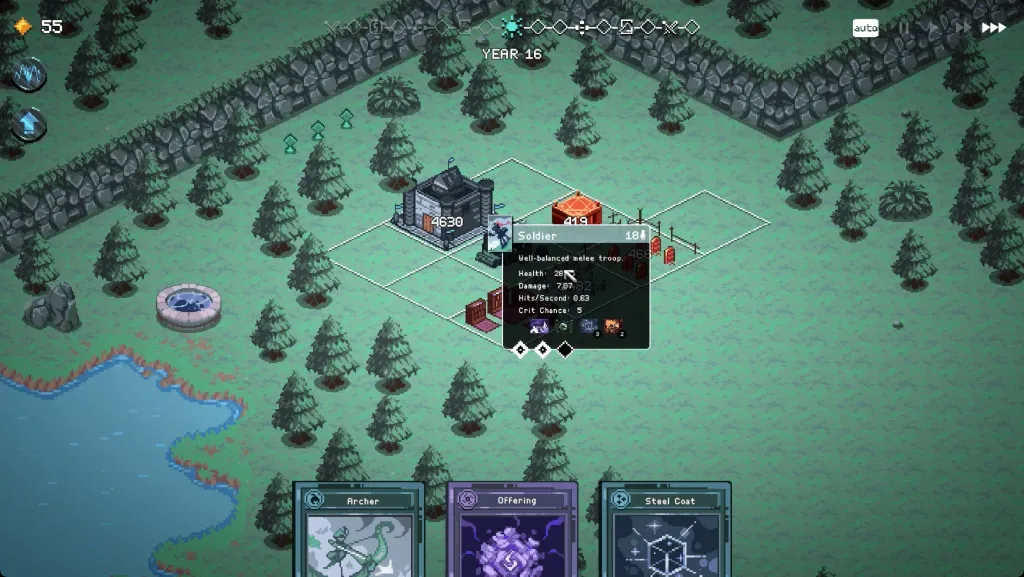
Inspect the relevant statistic on the intended plot. This historical screenshot illustrates where plot values appear.
Treat repeated-event plans as separate strategies
Time travel adds another layer to event planning, but it should not be treated as a requirement for using a blessing. The King of Time's Portal can revisit earlier years while preserving kingdom progress, creating opportunities involving events and accumulated effects. That broad mechanic does not establish an unlimited, automatic blessing loop.
Read the current Portal and event behavior before committing your whole run to repetition. Time travel has received multiple fixes, including the Patch #31 correction for a soft lock after traveling 33 years. Older examples can describe interactions or bugs that no longer behave the same way.
The standard Prophet event is described as a special encounter that does not simply recur on the normal endless schedule. Do not wait indefinitely for another identical Prophet visit merely because Royal Councils continue during a long run. Plan around the forecast you have, then evaluate any further event interaction on its own terms.
For ordinary play, the reliable workflow remains straightforward: identify the forecast, prepare a useful eligible plot, preserve the run, and inspect the result. A large blessing is most valuable when it strengthens a kingdom that already has a working combat plan.