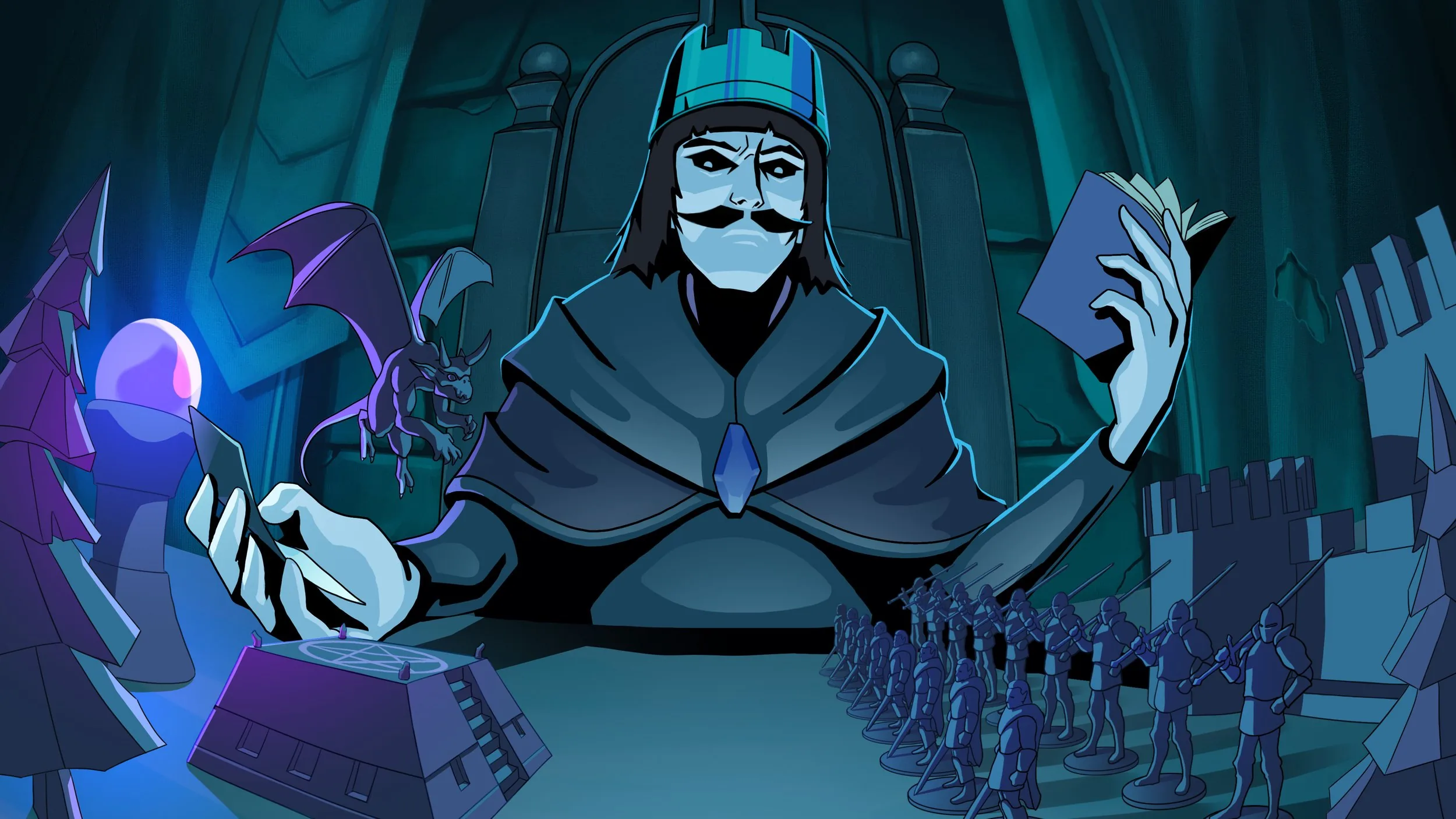
9 Kings gameplay revolves around drafting cards, placing or upgrading a small kingdom, and watching that kingdom fight enemy armies. Most decisions happen before the battle: choose a useful card, give it the right position, and support its effect over future years. During combat, the army largely fights automatically, with direct control available through the base's special attack.
You are playing a kingdom-building card game with an autobattler battlefield, rather than manually directing every unit. This guide explains the core loop in version 0.9.8, Patch #31, and the decisions that connect one year to the next. Individual builds and rankings depend on more specific cards, perks, and game modes.
Follow the preparation and battle loop
A run begins with a chosen king and that king's base card. The kingdom starts small, so the first placements define which cards can work together. A troop supplies units, a tower contributes battlefield damage, and a support building improves eligible plots or provides another continuing effect.
After a battle, you choose loot and use the next preparation period to improve the kingdom. The card pool draws from your starting king and the rival kings involved in the run. This makes the enemies you face part of your available strategy rather than just a sequence of obstacles.
Ordinary preparation limits how much of the hand you can keep: you play cards until two remain. That creates a real decision when several cards are valuable. You may need to place, upgrade, use, or discard cards before progressing. A hand full of theoretical future pieces can interfere with developing the kingdom you need now.
Before advancing, read each available action as a change to the board. A new troop adds a role. An upgrade improves an existing plot. A support building creates a relationship that may pay off repeatedly. A destructive Tome removes something in exchange for another benefit. Thinking in those terms makes the turn easier to understand than judging every card by its artwork or apparent rarity.
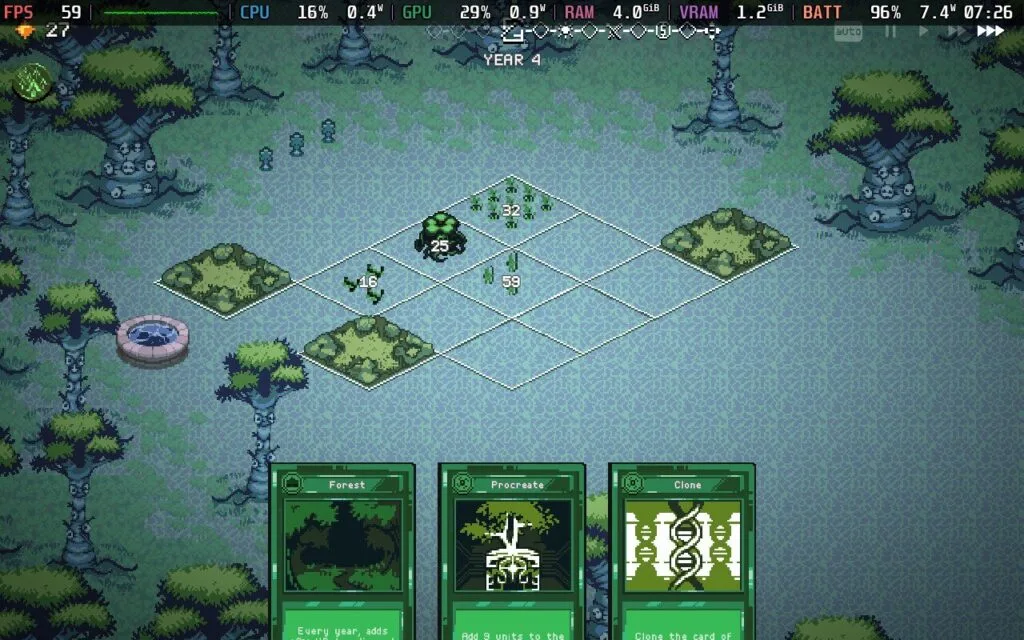
The hand and grid form the preparation stage; leave room for useful relationships.
Place duplicates to upgrade existing plots
Playing another copy of a card on the matching plot upgrades that plot. This is an important distinction from placing a second copy on empty land. The upgrade develops an existing investment, while the new placement creates another object that needs space and may need its own support.
Check the upgrade preview before committing. The game highlights which statistics or effects increase when you hold an upgrade over a placed card. This lets you compare the actual upgrade against a new placement without relying solely on memory.
Concentrating upgrades can be useful when a plot already receives several support effects. You preserve its position and build on the relationships surrounding it. However, a second plot can be necessary when the kingdom lacks another battlefield role or when a particular card's growth depends on multiple connected plots.
Level caps and unusual leveling behavior vary by card and effect. Lab Rats are associated with leveling chains, while certain decrees change troop or Vault level limits. Do not assume that every plot follows an identical cap simply because early ordinary upgrades appear similar.
Wildcard and Clone provide different ways to address card availability. Wildcard can upgrade a placed plot, while Clone can become a copy of a selected card. Read the current target and resulting card before using either. The useful choice depends on whether you need an upgrade or another placement, and whether the effect preserves the role you intend.
Make support placement deliberate
Many support effects reach adjacent plots in the four cardinal directions. A central position can touch more usable targets than a corner, but adjacency alone is not enough: the neighboring plots must be eligible for the effect and useful recipients of it.
Farm supports troop population, Forest supports troop HP, and Blacksmith increases damage for nearby eligible troops or towers. Library works with enchantments on adjacent troops. These are different needs. A kingdom with enough units but insufficient damage should not automatically add another population support simply because the space is available.
Reserve space for the relationship you want to create. If a troop is your main damage source, think about the support plots it can eventually touch before filling every nearby tile. An early empty plot can be a planned support position rather than wasted land.
Some effects have a wider reach. Quarry supports towers across the kingdom rather than needing to sit next to every tower. Check each card's text; a global effect and a local effect impose different placement requirements.
Patch #31 makes these relationships easier to read through support-building visual effects, selected-plot highlighting, and affected-plot highlights when placing Amplifiers. Use those signals together with the descriptions. The purpose is to confirm the targets the game recognizes before an important placement.
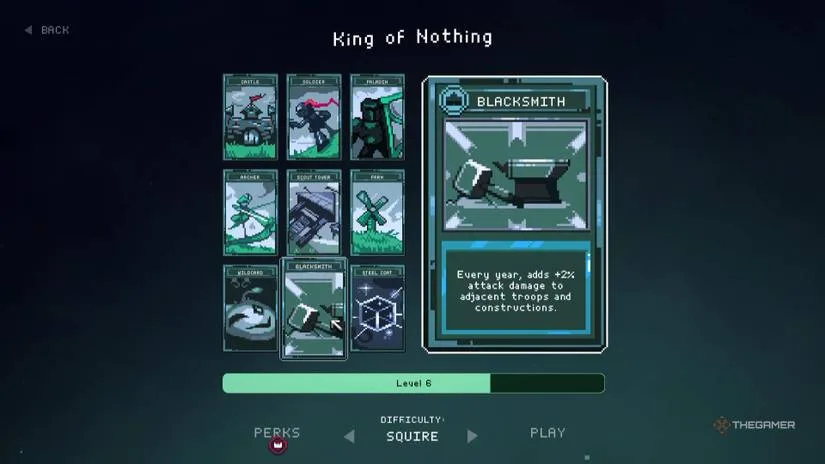
Historical interface illustration; use the current in-game description for effect values.
Balance the army's roles
A kingdom needs a way to stop or survive the enemy and a way to remove it. Those roles can come from different cards or from one developed plot with several supporting effects. A large number of troops does not automatically provide both.
Watch which failure happens first. If the enemy reaches your vulnerable damage sources immediately, defense or positioning may be the problem. If your army remains alive but cannot finish enemies, another defensive card may prolong the same losing fight without solving it.
Targeting matters as well. Elf attacks a distant enemy, while Executioner seeks a low-health target. A card that disrupts the enemy backline contributes differently from one that spends the battle engaging the nearest durable unit. Read the target behavior alongside damage and attack speed.
Growth cards need time. Mycelium develops a spore army over the run, and support buildings can repeatedly improve recipients. Placing an engine early creates more opportunities for its continuing effect, but an engine without immediate combat support can leave your kingdom exposed.
This is why the same card can be sensible in one hand and awkward in another. A future payoff is easier to justify when the current army can survive until it matters. If survival is already failing, prefer a change that addresses the specific failure before adding another layer of growth.
Use diplomacy to shape the card pool
War and peace influence which rival decks you encounter. The game's official description encourages declaring war on kings whose cards you want and making peace with those whose units do not fit your plan. These choices combine combat difficulty with access to future cards.
Before adding an opponent, name the card or role you hope its deck provides. If your troops need health growth, a deck with the relevant support may help. If a setup relies on enchantments, access to enchantment support can be more useful than another unrelated attacker.
Then consider the cost of fighting that opponent. A desirable card is not a guarantee that it will appear immediately. The enemy's army can challenge your kingdom before you draw the reward you wanted. Diplomacy is a trade-off, not a free search function for any card in the game.
Making peace removes that rival from the ongoing enemy and loot selection, while cards and plots you already acquired remain part of your kingdom. This allows a run to change direction after obtaining useful pieces. It also means that removing an opponent too early can reduce access to cards you still need.
Multiplayer uses a different diplomacy flow associated with kings being eliminated. Follow the mode's event display rather than carrying a singleplayer timetable into asynchronous PvP.
Read special encounters before spending resources
The Merchant exchanges gold for cards, with rerolls providing another way to search the offered inventory. Decide what would improve the kingdom before spending. A specific needed role gives you a stopping point; repeatedly rerolling without one can consume gold without changing the board's weakness.
The Royal Council offers decrees that can change the run's rules, effects, or available resources. Read whether a decree acts immediately or changes future behavior. An effect that improves active troops requires a different preparation from one that provides cards for the next turn.
The Prophet forecasts a delayed blessing. That warning gives you time to prepare eligible recipients. Do not mistake it for an instant support buff, and avoid removing the target you intended to develop before the blessing resolves.
Expansion opens more plots, but more land does not have to become more low-level troops. New space can let a support building reach the right recipients or create room for a temporary plot you plan to destroy. Evaluate the relationship enabled by the land, not only the number of open tiles.
Destructive cards require particular care. Offering, Sacrifice, Overhaul, and other effects can remove a plot in exchange for cards, upgrades, or another benefit. Before committing, check whether the plot contains the kingdom's main combat investment. Replacing a developed unit with a fresh copy does not mean every accumulated effect is preserved.
Choose the mode that matches your task
Singleplayer provides the core kingdom-building experience against rival kings. Quest Mode offers specific challenges with modified conditions as you travel the map and collect crowns. A quest's starting cards or special restrictions can make ordinary run advice incomplete, so begin by reading its stated rules.
Async multiplayer pits your kingdom against saved kingdoms from other players. You can think and act at your own pace, but the enemy builds come from a competitive population. The seasonal rainbow-card and decree pools also affect which combinations are available.
Endless play continues the survival challenge beyond the standard run. Patch #30 clarifies that year 99 is the game's true ending for progression messaging and that no additional EXP is awarded after year 99. You can choose to continue playing afterward, but that continuation should not be confused with unlimited experience farming.
Joker custom mode has been announced for the November 12, 2026 version 1.0 release. It is future content in this version baseline. Do not search the current menus for its promised custom nine-card deck controls as though they are already part of ordinary gameplay.
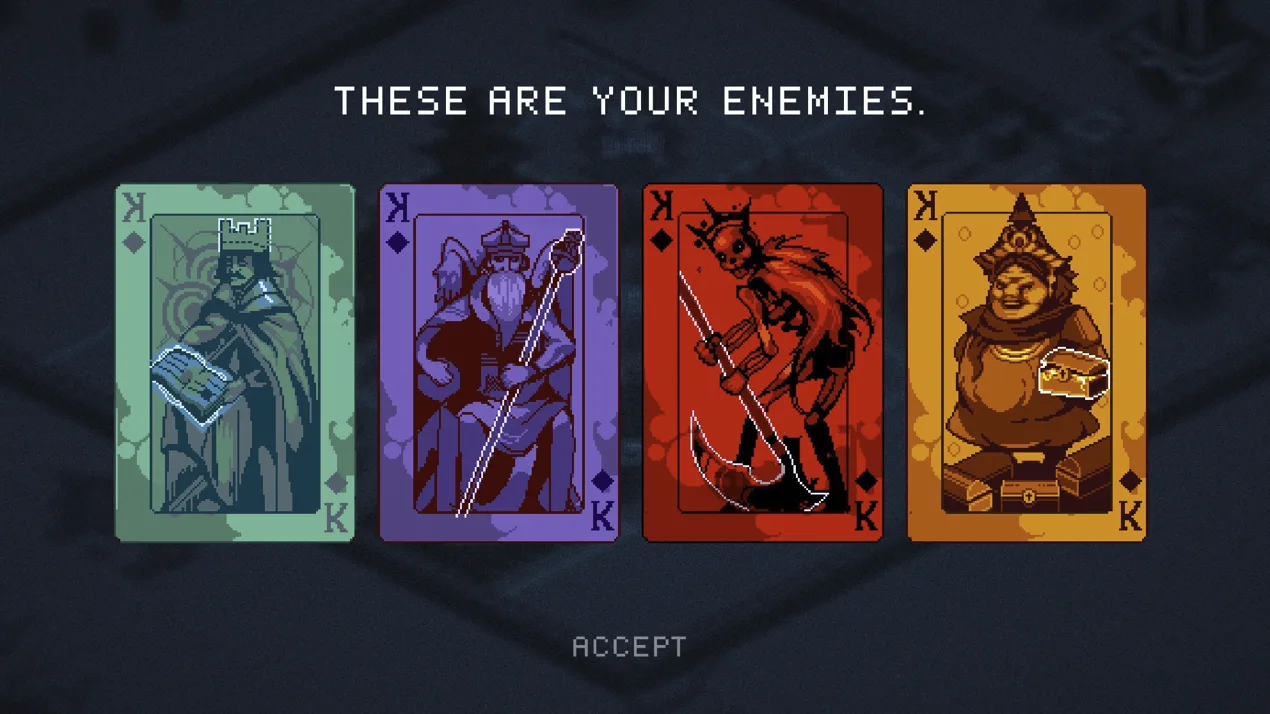
The enemy roster helps identify which rival decks are part of the run.
Check current behavior after an update
Card descriptions have changed substantially during Early Access. Reinforce now provides battle-time HP growth and healing beyond maximum HP, rather than increasing damage whenever another plot levels. The Blood deck's former Vampirism slot is now Oblation, and Recycler replaces the former Progress Precision slot.
Other differences affect what you see on the battlefield. Pagoda summons Ghosts, Cemetery summons Skeletons, and Mangler summons meat trolls. Vault levels automatically each year, and Mercenaries use the revised gold-per-unit cost. An older explanation can therefore describe a recognizable card name but the wrong current effect.
Use the current descriptions and Compendium statistics when checking an interaction. After a patch, start a new run so that updated run data applies. Then identify one board decision, inspect its result, and build the next choice around what the kingdom actually needs.