
9 Kings perk combinations work through eligibility and position. Leftist increases the perk to its left, Verticalist affects perks immediately above and below, and Nationalist affects adjacent king perks. Put a useful regular perk in the correct target slot before adding another multiplier. Extra applications have value only when the recipient changes the run you intend to play.
This guide focuses on arranging a loadout for version 0.9.8, Patch #31. It explains the relationship between multiplier perks and regular effects rather than claiming one historical screenshot is the best arrangement for every king. In multiplayer, Moderate and Authoritarian have explicitly fixed application counts that need separate attention.
Name the regular effect you want to increase
Begin with the kingdom, not the multiplier. Identify the card or opening you want the loadout to support. An additional starting card, more troop damage, a stronger summon, or a card-specific trigger changes a different part of the run.
For example, a Wizard-centered plan can make use of Arcane's enchantment-related damage. A Cemetery opening can use Blighted's Pile of Bones reward. A kingdom built around Trapper control can use Hunter's longer stun. These are concrete regular effects with recipients you can name.
The same multiplier does not make all three interchangeable. If your loadout increases Arcane but the opening has no Wizard, the immediate combat problem remains. If you increase Blighted without a usable Cemetery placement, the theoretical reward still lacks its trigger.
Choose a small number of priority effects. This gives you a reason for each boosted slot and makes trade-offs clearer. A loadout with many mildly improved effects can be appropriate, but it should arise from several useful roles rather than from an assumption that the maximum number of highlighted perks always wins.
Read the direction of every rainbow perk
Leftist has a specific horizontal target: the perk directly to its left. Put it on the correct side of the intended recipient. A perk in another row or on the right does not become the target because it is visually nearby.
Verticalist affects vertically adjacent perks. Its immediate recipients are above and below, so a central position can reach two filled target slots. Place useful regular effects there, or deliberately target another eligible rainbow effect if the resulting layout supports the plan.
Nationalist targets adjacent king perks. That eligibility restriction matters. A universal perk next to Nationalist is not the same recipient as a king-specific perk. When reviewing the arrangement, inspect both the slot relationship and the category of the regular effect.
Expander changes the space available in the perk layout. More positions can allow another regular perk or a different multiplier arrangement, but Expander itself occupies a slot. Count the useful additions and their effects rather than treating the expanded shape as free power in every situation.
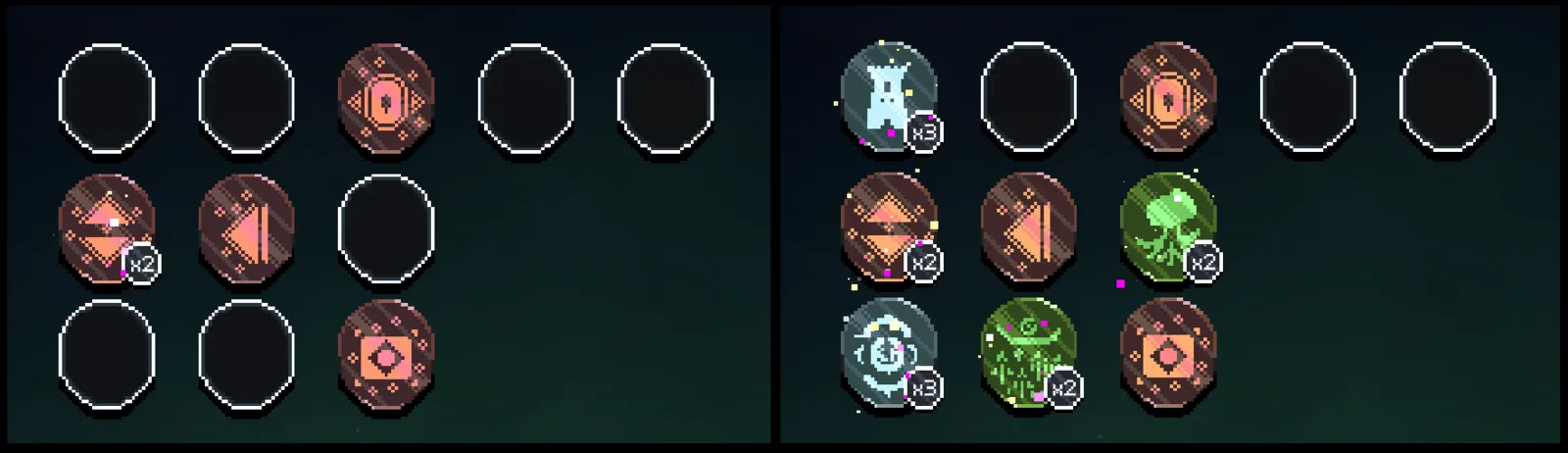
Illustrative perk arrangement. Read the current perk screen for effective applications and eligibility.
Assemble a focused king-perk arrangement
A focused arrangement aims to increase a few king-specific effects that jointly support one engine. Nationalist provides a natural center for this idea because its eligible targets are king perks. Place the priority king effects around it, then evaluate whether Leftist or Verticalist can improve the relevant layout.
The attraction is concentration. If the opening needs several copies of a particular starting card or a strong card-specific bonus, increasing that effect can make the first board more coherent. The limitation is that the loadout spends positions on multipliers that do not themselves provide a troop or tower.
Before committing, check the effective values shown by the game. Historical examples often label arrangements with names such as triple or double Nationalist and attach precise application counts. Those counts describe the source's particular system and position, not a universal rule independent of the current perk screen.
Then inspect the rest of the loadout. A focused engine may still need a general defensive effect, rerolls, or another opening card. If concentration removes every answer to an early combat weakness, the final multiplier may never translate into a useful developed kingdom.
Use the layout as a way to make the planned opening more reliable, not as permission to depend on cards that the run does not guarantee. The starting king and equipped perk effects should provide enough of the foundation that the arrangement has a practical first turn.
Arrange broader effects when several roles matter
A broader arrangement gives useful applications to universal effects and more than one king-specific role. Verticalist and Leftist can be suitable when the priority recipients do not all belong to the king-perk category that Nationalist requires.
This can support a kingdom that needs both opening stability and a later engine. For example, a general troop effect may help the first fights, while a card-specific effect develops the selected king's distinctive mechanic. The combination works when both recipients contribute to the same intended run.
The trade-off is reduced concentration on one effect. Do not compare the layouts by counting multiplier labels alone. Compare what the changed regular values do: additional starting cards, eligible troop statistics, more duration for a control effect, or another trigger reward.
A useful way to evaluate an arrangement is to remove one multiplier temporarily in your planning. Identify which regular effects would become weaker and which useful effect could occupy the freed slot. If the lost applications barely affect the intended kingdom, the extra regular perk may be a more coherent choice.
Keep the comparison tied to availability. A layout that requires a rainbow perk you have not unlocked is a future option, while a smaller working arrangement can improve the current run. Do not leave useful slots empty simply to imitate the outline of an unavailable final layout.
Evaluate Expander by useful occupied slots
Expander creates additional room, giving you another way to accommodate regular effects or arrange multiplier targets. The gain is not just the size of the grid: it is the number of useful effects you can place and the relationships the extra positions make possible.
After placing Expander, inspect where the new positions appear. Put the intended regular perks into those positions and check whether they actually receive the multipliers you planned. A larger board with target relationships pointing into empty spaces can be less useful than a smaller fully functioning arrangement.
Count the opportunity cost as well. Expander and any multipliers dedicated to increasing it consume positions that could otherwise hold direct effects. If the added positions let you equip several effects that the kingdom uses, the exchange can make sense. If they mainly make room for unrelated bonuses, the apparent expansion may contribute little.
An expanded loadout can be helpful when the opening has several distinct requirements. It is less compelling when the plan depends almost entirely on one regular effect and the extra slots distract from it. Review the actual run needs before deciding that a wider arrangement is automatically preferable.
Save the completed arrangement in one of the game's three loadout slots for the chosen king. This lets you keep a focused option and an expanded option separately, making later comparisons more deliberate.
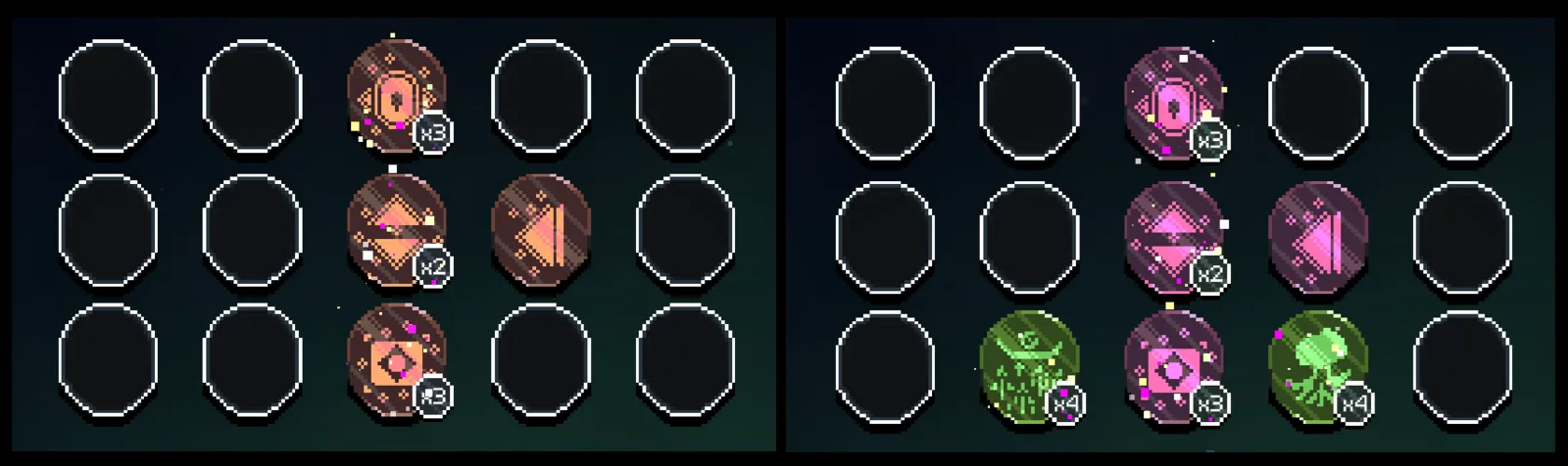
Illustrative perk arrangement. Read the current perk screen for effective applications and eligibility.
Apply the current fixed multiplayer rules
Moderate now sets universal perks to two applications, no more and no less. Authoritarian sets the top-left regular perk to three applications, also as a fixed count. These Patch #30 definitions are important because they differ from a general instruction to add another application.
When one of these effects is active, read the effective result before combining it with directional multipliers. Do not assume that every nearby bonus stacks above a fixed value. A layout built on that assumption can spend multiple slots without producing the increase its diagram promises.
Authoritarian also makes location decisive. Identify the top-left regular perk and ensure it is the effect you meant to emphasize. Moving a regular perk can change the recipient even if the collection of equipped names remains identical.
Multiplayer planning also depends on the seasonal decree and rainbow-card pool. A perk loadout may prepare one engine well but still require a special card absent from the season. Check the lobby pool before interpreting the arrangement as a complete competitive strategy.
Vigilant provides additional opening protection. If you include it, plan what the protected years let the kingdom establish. Protection gives time to develop a board; it does not substitute for having a useful damage source and the supports that let it act.
Combine updated regular effects deliberately
Arcane now increases Wizard damage for its enchantments. Sorcerous increases Warlock HP for Tomes used. These effects can both belong to Spells, but they support different recipients and actions. Multiplying the one that fits the actual troop is more useful than assuming any Spells perk strengthens every Spells plan.
Brutal gives all troops an initial Adrenaline stack. Patch #31 also makes Orbiter correctly receive enchantments from adjacent troops placed with pre-applied enchantments. This supplies a specific placement interaction to inspect; it does not mean every troop anywhere on the board transfers its enchantments automatically.
Blighted adds a Pile of Bones when a Cemetery is placed, while Trashy adds a Trash card when Recycler is destroyed. These are trigger rewards. A multiplier improves a reward only when you can generate its trigger in a way that still leaves the kingdom functional.
Hunter improves Trapper stun duration, and Toxic makes poison ticks faster. Neither should be described using the older straightforward damage bonus. Destructive is now forty percent per stack in Patch #31, which supersedes its Patch #30 value.
Read these changes before copying an old multiplier calculation. A correct arrangement applied to an outdated regular effect is still an outdated plan.
Review the arrangement through one concrete run
Before starting, inspect every multiplier target, each recipient's category, and the displayed regular values. Then connect the loadout to the first board: which card provides combat, which effect helps establish it, and which growth action follows.
After the run, separate a placement error from a strategy failure. If a priority perk received no multiplier because it sat in the wrong slot, correct the arrangement. If the multiplier applied but the kingdom lacked a frontline, changing the multiplier may not address the actual problem.
Avoid treating one result as proof of a universal optimum. Draws, opponents, available cards, and mode conditions also affect the outcome. Use the loadout to make a specific part of the run more coherent, preserve the version context, and change one meaningful relationship at a time.
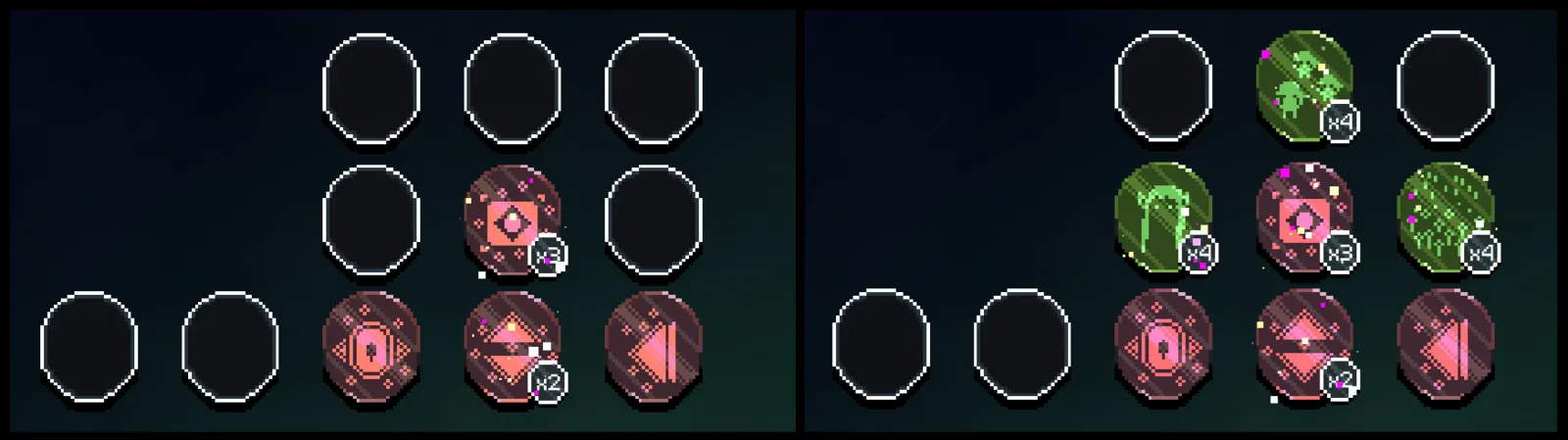
Illustrative perk arrangement. Read the current perk screen for effective applications and eligibility.