
Overwork is a top choice for a working support engine, Supplies is a top choice when replacing your current hand solves an incomplete opening, and survival or direct-combat decrees can outrank both when the next fight is unsafe. Bunker fits tower damage, Feast fits durable troop plans, and Venom fits a kingdom already applying poison. The decree must improve your board, not merely appear high on a list.
These are conditional editorial tiers for version 0.9.8, Patch #31. They rank practical uses of selected decrees rather than claim measured win rates or complete current-meta coverage. Multiplayer now uses a seasonal decree pool, so check availability before planning around any named choice.
Read the council as a board decision

Council choices illustrate distinct build roles; use current descriptions and the current mode pool.
Royal Decrees are chosen at Royal Council events and can change a run immediately or improve its future development. Their value is unusually dependent on timing. A support activation bonus selected early for productive buildings has more opportunities to matter than the same bonus selected after the growth phase has mostly passed.
A decree can also be urgent rather than scalable. If the kingdom lacks a fighting force, receiving usable cards may be more important than improving buildings you do not yet have. If the force is about to collapse, an immediate survival improvement can preserve the attempt and all previous investment.
Start each council by naming the problem: insufficient cards, low damage, poor attack cadence, weak survival, missing space or an incomplete specialist engine. Then compare the offered decrees against that problem. This gives the tier a role in the decision without allowing a generic ranking to override the next battle.
S tier when the prerequisite exists
| Decree | Recommended priority | Why it can lead the choice | Downgrade it when |
|---|---|---|---|
| Overwork | Productive support engines | Adds an activation to support effects | Useful support buildings are absent or the next fight needs direct strength |
| Supplies | An incomplete opening with a replaceable hand | Replaces your current hand with the nine cards from your king's deck | You would lose valuable off-faction, rare or plan-critical cards already in hand |
| Rebirth | Recovery or additional life capacity | Current effect grants lives beyond the maximum | More lives will not help repair the underlying board |
| Re-enchant | An established enchantment force | Multiplies existing enchantments | The intended troops lack useful enchantments |
| Engineering | A tower-centered kingdom | Strengthens tower damage | Troops or another role do the meaningful work |
| Splicing | Developed Lab Rats | Builds on their accumulated levels | The rat engine is missing or its starting levels offer little value |
The table deliberately includes both broad and specialist choices. Re-enchant can be the best decree on a developed enchantment board and nearly empty value on a fresh troop without useful stacks. Splicing is similarly tied to a rat kingdom that already exists. Do not take a specialist S-tier effect simply because the ruler can eventually support it.
Rebirth deserves a current-version reading. The deck rework changed it to grant three lives beyond the maximum rather than merely restore lost lives. An older ranking assessing only a refill is evaluating a previous effect. Its usefulness still depends on whether the additional attempts give you time to strengthen the kingdom.
Why Overwork is a conditional leader
Overwork adds another application of support-building effects. Its attraction is the number of useful relationships it can improve: damage development, population growth, health growth and other support jobs. A board with several productive buildings can gain more than a single isolated recipient.
The prerequisite is productive support. If a Blacksmith cannot reach the carry or a Farm has no valuable troop recipient, another activation repeats a weak relationship. Fixing the recipient, improving the attacker or obtaining a missing defensive card may be more important than accelerating the unused engine.
Timing matters as well. Recurring support benefits from subsequent years, so a stable kingdom can prefer Overwork earlier. A collapsing kingdom may need direct power immediately. Do not allow the promise of future compounding to consume the last chance to survive the next fight.
Patch #30 made Overwork work with Vault. That current interaction gives an economy plan another reason to consider it. It does not establish that Overwork is the best decree for every Greed board; inspect how income, reserves and the fighting force connect in your actual run.
Supplies when the kingdom needs options
Supplies replaces your current hand with the nine cards from your king's deck. It does not add those cards while preserving the hand you already hold. That makes it a strong early candidate when your current hand is expendable and several missing jobs can be filled from the starting deck. The replacement creates options to place support, upgrade existing plots or assemble a more coherent opening.
The card package is still specific to the current ruler. You need to decide which cards improve the existing board and which can be held, discarded or used as part of another effect. Taking a large package without a plan does not guarantee that every card becomes productive.
Downgrade Supplies when you hold valuable off-faction cards, rare cards or a specific card needed to finish your plan. Replacing those cards can remove tools the nine-card package cannot restore. Its value also falls when the kingdom already owns the important recipients and upgrades, particularly if the next battle's problem is a narrow stat shortage. A direct damage or survival decree may then supply the missing benefit more clearly. Compare both the resulting board and the hand you would lose, rather than simply counting the cards received.
Supplies is a decree, not a perk. It cannot be inserted into the pre-run perk page because a community discussion casually called it a perk. Keep the timing and acquisition route clear when planning the opening.
A tier for immediate combat and access

The calendar indicates upcoming council events.
| Decree | Strong use | What to inspect |
|---|---|---|
| Bunker | Towers needing more attack speed | Whether towers are important damage recipients |
| Feast | Durable troops or a health-centered force | Whether the extra health changes survival |
| Sharp Blades | Direct damage across useful attackers | Whether damage is the current limiting factor |
| Eyeglass | Critical chance on productive attacks | Whether those attacks occur often enough to matter |
| Iron Fist | A force already benefiting from critical hits | Whether the board supplies meaningful critical attacks |
| Exploration | A kingdom constrained by space | Whether there are useful cards to occupy the new plots |
| Outsourcing | Targeted reward or shop search | Whether you have a clear search priority |
| Bargain | Planned merchant purchases | Whether shops can supply the actual missing roles |
Direct combat effects can be more valuable than an elaborate growth decree when the current wave is the problem. Bunker is not a substitute for a damaging tower, and Feast is not a substitute for enough attack. Each solves a particular part of the relationship between surviving and clearing the enemy.
Eyeglass and Iron Fist should also be considered together with the existing attack pattern. Increasing critical damage does not make an inactive or immediately defeated attacker useful. If your force already delivers productive attacks and crits are part of the plan, the choice can have a much clearer purpose.
Exploration supplies random plots. More space is valuable when you have recipients and support that need room; it is less useful when the existing board is weak because it lacks upgrades or fighting strength. The unlock itself does not build a useful kingdom.
Outsourcing and Bargain supply access advantages. Use them with a target, such as finding a needed duplicate or buying a support piece. Without a target, more rolls and cheaper purchases can encourage collecting unrelated cards rather than improving the central plan. Bargain is now universal after the deck rework, replacing the older Greed-only classification.
A tier for specialist growth
Venom belongs near the top when the force already applies poison reliably. Poison Thorns can fit durable troops that endure attacks, while Weakspot supports a force applying relevant conditions. Each requires the condition to exist. A poison-related decree taken before the kingdom can apply or sustain poison may not address the current fight.
War Horns fits useful summons. Blood's current deck includes Ghosts, Skeleton interactions and Mangler's meat-troll summons, so the old habit of labeling every Blood summon as an Imp is misleading. Evaluate the summon that actually contributes and how its production is supported.
Bloodbath connects Oblation's population effect with damage growth. That is a specialist decree for a current pit-based interaction. It deserves consideration when that interaction is part of the plan, but the name alone is not a reason to discard cards the kingdom still needs.
Futurism now allows troops to level up to level 99. That makes it an upgrade-oriented option, but level capacity needs a route to levels. A kingdom without useful upgrade actions gains less from the possibility than a board already organized around repeated development.
Current king-specific choices should follow the recipient and trigger. A decree supporting Dragons, Archers, Cemetery or a base has no universal value detached from those roles. The strongest specialist effect is the one you can connect to a working plot and a realistic next action.
B tier for a narrower or riskier situation
| Decree | Useful scenario | Reason to be selective |
|---|---|---|
| Loan | Gold immediately turns into combat value | Resources must improve the board or a reserve-dependent force |
| Leatherworks | Movement is preventing troops from contributing | Faster movement is not an answer to every damage shortage |
| Gunpowder | Area attacks are the damage plan | The relevant attacks must already exist |
| Gambling | Broader random card flow suits the engine | You give up ordinary control over loot selection |
| Refraction | Replacing the hand can rescue or transform the plan | It can also remove useful cards you already own |
| Longtermism | The kingdom can survive to the next council | It postpones part of the benefit |
| Rare Goods | The plan can use rainbow shop access | Access alone does not guarantee the desired card |
| Havoc | Repeated plot destruction is productive | The destruction cost must be affordable |
A lower broad tier does not make these bad decrees. Loan can be immediate strength when gold feeds Mercenaries or a critical purchase. Gunpowder can solve a crowd problem in an area-damage plan. The ranking reflects how specific the prerequisite is, not the peak value when it is satisfied.
Gambling and Refraction deserve particular care because they change access and control. If your build needs a narrow sequence, a random package may disrupt it. If the current hand cannot serve the kingdom, the same effect may provide a useful alternative. Decide from the hand you have rather than assume randomness is always good or bad.
Longtermism is another timing choice. A later council advantage has value only if the force can reach that council. A decree that helps survive now may therefore outrank it in an unstable run, while a stable kingdom can consider the future payoff more deliberately.
Current changes that invalidate old rankings
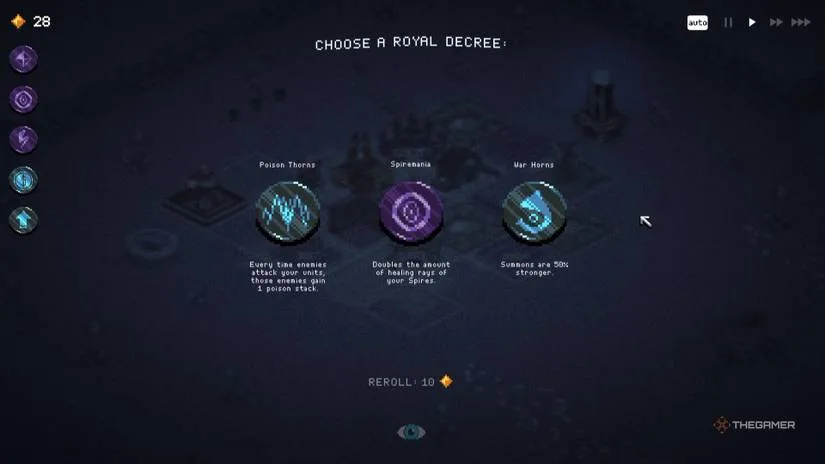
Choose the decree that addresses the existing kingdom; this is an older interface illustration.
Twinshot now doubles Archer projectile count rather than adding one projectile. Static Fields was renamed Tempest. Rebirth grants lives beyond maximum. Bargain is universal. These changes affect both labels and priorities, so an old decree screenshot is not a current numerical reference.
The new rainbow decrees introduced in Patch #30 include Rare Goods, Havoc and Rebound. Their presence also means old claims about a fixed small total of rainbow decrees are obsolete. This list does not invent a complete present count from an outdated table.
Blood, Progress and Stone received deck and decree reworks. An older ranking built around Vampirism, upgrade-damage Reinforce or the former Precision role may be evaluating an engine that no longer exists. Check the card interaction before accepting the decree recommendation attached to it.
The latest patch's seasonal pool matters separately from those effect changes. Multiplayer's pool contains eighteen universal, six rainbow and six decrees for each king. That is the pool structure, not a declaration that the entire game only contains those decrees. Inspect the current season rather than infer availability from a general database.
Make the council choice in order
First, check whether the next battle is safe. If it is not, prefer a decree that produces usable strength, cards or recovery now. Second, identify the productive engine already on the board. Choose growth when its recipients and triggers exist. Third, examine access needs such as space, rerolls or merchant prices.
Finally, compare the long-term alternative against the specific cost of passing the immediate choice. A strong support decree can be correct for a stable kingdom, while a direct troop benefit can be correct for the same build at an earlier, fragile stage.
After selecting, check the relevant tooltip or recipient and observe the next fight. If you expected a faster tower, a stronger troop or more support activations, verify that particular change. The decree earns its place through the job it performs in your kingdom; its tier is a starting point for that decision.